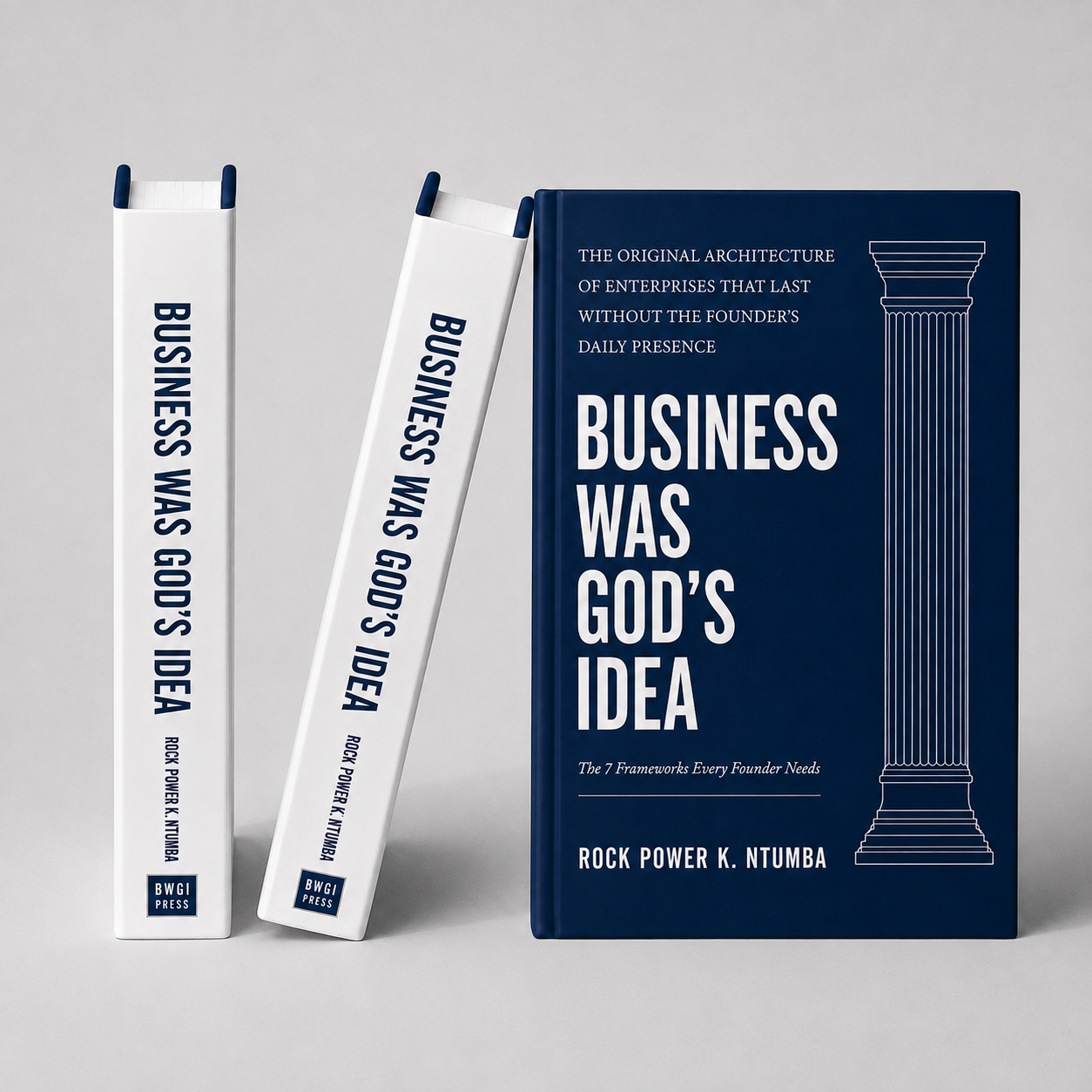
Why Business Was God's Idea

But What If Business Began Long Before Any of Them?
When people think about business, they think of capitalism, investment, entrepreneurship, stock exchanges, financial centers, and innovation. We often speak of these as though they were the beginning of business.Business did not begin on Wall Street. Wall Street transformed business. It did not begin it. Follow it back far enough and it ends somewhere older than the first bank, the first contract, the first trade — before commerce had a name.
I started in Dubai, the city where I live and build. Silicon Valley told the same story in a different accent. Singapore made the point unmistakable. China made the argument on a different scale entirely. Every one of them quietly built its governance, systems, and succession on principles Phoenician merchants and Babylonian grain traders had used thousands of years earlier. Wall Street traces itself to twenty-four brokers beneath a buttonwood tree in 1792 — formalizing what merchants had done for millennia. Behind them stood the Medici banks. Behind those, the Phoenicians — who invented the alphabet not for poetry, but to keep their accounts. And still the trail kept going — to Mesopotamia, where six thousand years ago temple administrators recorded grain loans on clay tablets, writing itself emerging because commerce demanded it.Trade preceded literacy. Five thousand years, and the structure of a binding agreement has not changed.
Something becomes visible when you lay all of this side by side. The products, the technologies, the currencies, the languages — all of them changed. And yet certain things never did: trust, governance, structure, systems. The marketplace evolved without pause; the pattern beneath it did not move at all.That enduring pattern is what this book is about.

Wall Street formalized markets.
Every Age Believed It Invented Business. Wall Street formalized markets.
Adam Smith explained commerce. The Medici transformed banking. The Phoenicians advanced trade. Each was extraordinary. None was the origin. Long before any of them, civilizations were already establishing order, organizing resources, building institutions, and creating lasting value. Six thousand years ago in Mesopotamia, temple administrators recorded grain loans on clay tablets — writing itself emerged because commerce demanded it. Trade preceded literacy.
Hammurabi did not create commercial law so much as record what was already running. And in the oldest contracts ever recovered, from Sumer: offer, acceptance, obligation, witnesses, terms of default. Five thousand years, and the structure of a binding agreement has not changed. As I traced the history of enterprise backward, I found something I did not expect. Products changed. Markets changed. Technologies changed. Empires rose and fell.
But the architecture beneath them never did.
Trust. Governance. Structure. Systems. Across centuries, these patterns remained remarkably consistent.Business did not develop its own language. It inherited one, and called the inheritance innovation.
Consider the word the modern economy now organizes itself around: creator — the creator economy, the creator era, claimed in every marketing meeting on earth. In its origin the word names one staggering act: bringing something into existence out of nothing. It was never a marketing term.
That raises the only question that matters to a builder: if the language was inherited, did it also inherit the architecture—the order in which durable things are built?It did.
This is why I say Business Was God’s Idea. Not because every business is religious, but because the architecture that allows enterprises to endure was demonstrated before the first marketplace existed.
We did not invent that architecture. We inherited it.This book traces that architecture back to its earliest discoverable source and shows how it can be applied to the organizations we build today.
Build what can outlive you.