
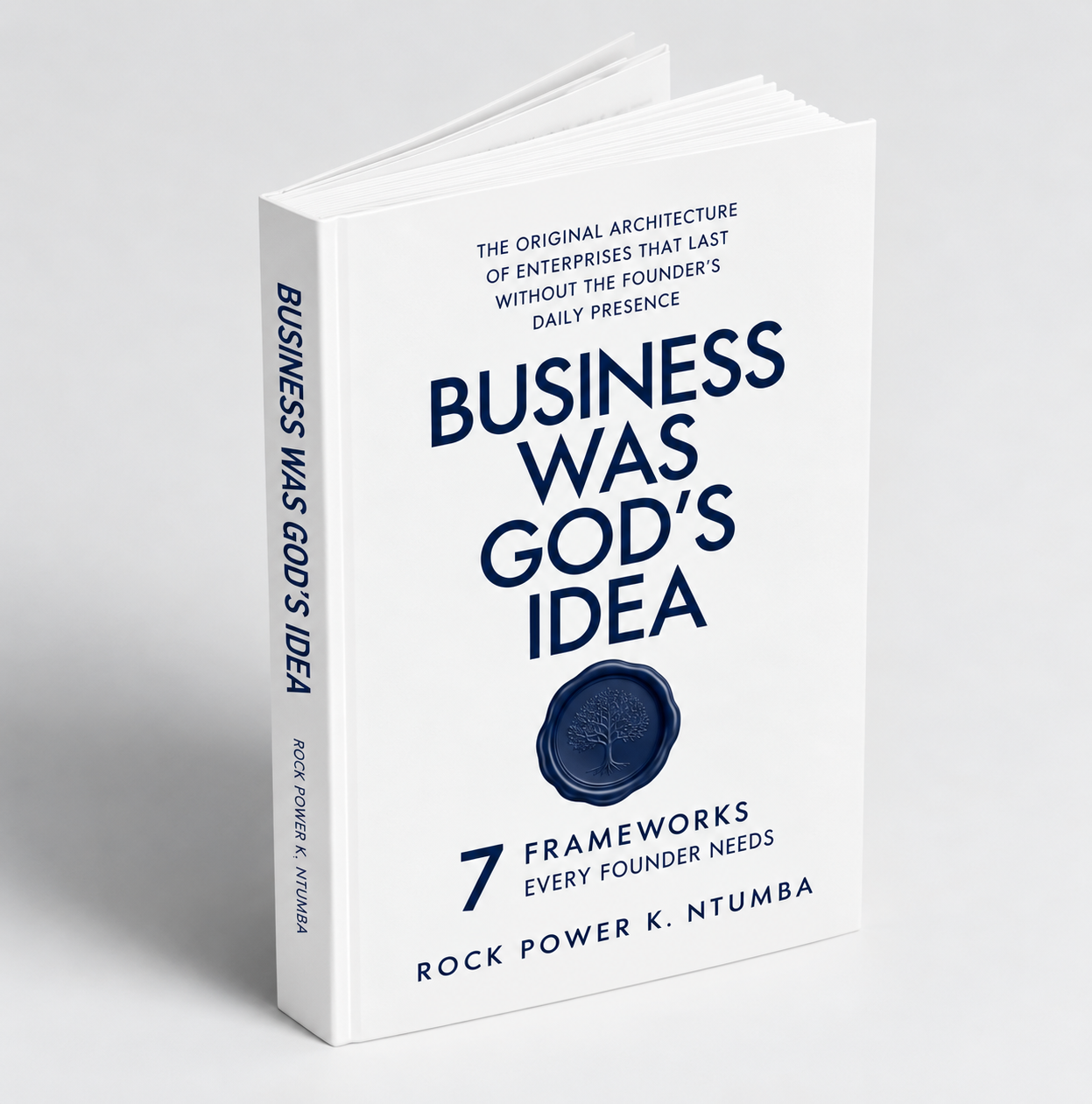
Business Was God's Idea
The Original Architecture of Enterprises That Last Without the Founder’s Daily Presence

The Problem Isn't You. It's Your Architecture. If your business depends on your daily presence, it isn't built to last.
Every founder eventually discovers the same paradox.
As the organization grows, so does its dependence on the founder. Decisions return to one desk. Leaders wait for approval. Growth increases responsibility instead of creating freedom.
Business Was God’s Idea presents the Genesis Enterprise 7 Frameworks™️—a practical enterprise architecture built on one foundation and seven sequential frameworks that move organizations from founder dependence to institutional endurance. Together, they provide a practical blueprint for building organizations that continue to grow, make decisions, develop leaders, and create value without depending on the founder’s daily presence.
The oldest organizational blueprint in history may still be the most misunderstood.
Discover the blueprint for building an enterprise that grows, scales, and endures beyond its founder.
Business Was God's Idea approaches Genesis not primarily as a devotional text, but as the earliest recorded blueprint for organizational design. It reads Genesis as an architectural sequence that still governs how enduring organizations are built:
Alignment before Vision.
Vision before Structure.
Structure before Systems.
Systems before Governance.
Governance before Scale.
Scale before Representation.
Representation before Rest.
The order is not decorative. It is the order in which durable things are built. This is a structural investigation into how enduring systems are built.
Read it through faith or simply as architecture — the principles hold either way.
"You do not have to share the author's faith to test the architecture against reality."

Research & Methodology
Every case study in this book is drawn from the public record — annual reports, regulatory filings, court documents, published journalism, verified biographies. None comes from a private consulting engagement; those relationships remain confidential and are excluded entirely. No organization in this book is a hero or a villain. Each case illustrates a principle, not a verdict.
The conclusions are drawn from recurring patterns observed across organizations, industries, institutions, and generations. Individual examples illustrate those patterns; they do not create them. The architecture comes first.
This book is not about the size of an enterprise; it is about its architecture. Architecture precedes scale. Whether you are building your first business or leading a global enterprise, the same principles determine whether an organization becomes dependent on its founder — or learns to endure beyond the founder's daily presence.
What you will learn
Why the most successful founders are so often the most trapped by what they built.
The seven-framework sequence behind organizations that endure — and why order is everything.
How to diagnose exactly where your organization is most dependent on you.
How to build systems that perform at standard whether you are in the room or not
Who it is for
Founders and entrepreneurs
Pastors and Churches
CEOs and executives
Family enterprises
Institutions, ministries, and governments
Investors and family offices
Anyone building something that must continue whether they are present or not
Inside the book
Eight chapters, mapped to the seven days of creation plus the foundation that precedes them. Each framework includes the Law itself, numbered sub-laws, a "Signs you need this framework" section, an "Ask yourself" reflection, "A note on limits," and a pointer to the Genesis Architecture Scorecard.